Pages

Wednesday, July 11, 2012

Bleeding definition, causes, complications, types, and ways to resuscitate it.

The definition of bleeding:


Bleeding is the loss of a large amount of blood outside the blood circulation.
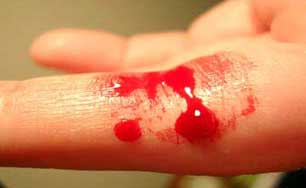


Causes of bleeding:

1 - blood diseases such as lack of factors that help clotting (platelets).
2 - wounds and injuries.
 3 - during or after surgery.
 4 - result of the explosion and the bleeding blood vessel, such as bleeding from the duodenal ulcer - tuberculosis respiratory - oesophageal varices .....
. 5 - continued use of certain drugs which lead to blood thinners such as aspirin.

Bleeding complications (very important).

 1 - lose blood
 2 - shock                        =             Death
3 - Pain
4 - microbial contamination

How to stop the bleeding


1) Wash your hands with soap and water and wear gloves to protect yourself.

2) If a party to the part that bleeds upper or lower, then raise it above heart level to reduce the bleeding.

3) Press the place directly above the bleeding using a bandage
.


4) If bleeding does not stop clicking your highest level to close the bleeding artery fed (if the red blood opening) or by pressing the bottom level to close the bleeding vein (if blood is dark red).
5) If the bleeding does not stop, do the arterial pressure (tourniquet) and are made in case of bleeding and the parties do not work only after the failure of all previous attempts, because they lead to prevent the circulation of the party  as a whole (very serious).


- How is the work of the arterial pressure?

Wrap a piece of broad cloth over twice the level of bleeding, and then make a node and then the other node, place a wooden stick or a pen and then roll the stick or pen until the closure of the artery completely.

Write the time you work pressure of the arteries, because you are removing the pressure every 20 minutes for 20 seconds until the blood passes to the injured party (to avoid gangrene).


6) When the bleeding stops or slows down we have to make a bandage:

- Specification that the bandage should be used:

* it must be sterile.

* it must be of material does not stick to the wound.

* it must have the ability to absorb the blood well.


- Wrap the bandage over the wound, to occur direct pressure, and at the same time to cause pieces of the blood of the parties (can work choose to know you bandage wrapped firmly or not, and that by raising the party who is bleeding above the level of the heart, and pressure with the fingers on the hand or foot, as if the party who returned to bleed pink color of the skin after more than two seconds of pressure, this indicates that the bandage wrapped hard and must be expanded)


- If the bandage soaked place above the other, and if saturated second place third, if saturated, remove the second, third and so on ... Does not remove the bandage so as not to lose the first blood clot that formed to stop the bleeding (the maximum number of bandages is three).
Types of bleeding:


 - External bleeding


 Is a blood loss through injury of the skin.


 Internal bleeding:


 In these cases could be out of the blood inside the body to the outside through natural openings, such as the following cases
: 1 - bleeding from the nose (epistaxis).
2 - bleeding from the stomach (vomiting contagious).
3 - bleeding from the urethra
Bleeding from the anus (rectal bleeding).
Bleeding from the vagina (vaginal bleeding).
And there are other cases where there is internal bleeding, and no blood comes out of the human body (such as brain bleeding ) :-
Note the symptoms of shock:(Shock, the possibility of internal bleeding.


Pallor.
A cold sweat
Very weak.
Rapid and weak pulse.
Breathe slowly and deeply.
                                                           {Bleeding ear}
Ambulance bleeding ear
 *The patient is sitting or lying on his back.

* Leaning his head on the ear, which bled.

* Place a clean bandage over the ear and plug pressure bandages.
*Not packed with gauze infected ear.


* If the bleeding is the result of wound surface in the outer part does not transfer the patient to the hospital.


* In case of bleeding from the inner ear move the injured to hospital.


                                                          {Bleeding nose}


Causes of nose bleeding


* Wound in the nose.

* Punch to the nose.

* Dryness of the mucous membranes lining the nose.

* The continued use of some medications that cause blood thinners such as aspirin.

* Develop a foreign body in the nose.

* Inflammation of the nose.

* Rise in blood pressure.

Ambulance bleeding nose.


* The patient sits leaning forward.

* Avoid raising the head of the injured back and to avoid swallowing blood or inhaled.

* Place the ice over the nose.

* Must avoid the infected nose suffered any injuries.


Ambulance vaginal bleeding (pregnant woman, or after birth).


1 - lift the pelvic area and put a pillow.
2 - cold compresses on the abdomen.
3 - annexation of the thighs instead of direct pressure.
     Important Note           
In case of bleeding from the anus or urethra or vagina, or the stomach, the patient is transferred immediately to the hospital.
Signs of serious bleeding
1 - continued bleeding despite a large amount of pressure on the place of bleeding for at least 15 minutes.
2 - a severe pain.
3 - bleeding from the vagina of a pregnant woman, or after birth.
4 - out of blood, of the human body openings.
5 - shock.


Tuesday, July 10, 2012

Definition of wounds, types of wounds, wounds ambulance.

Wounds are a disruption in the body tissues.


* Wounds are divided into: -

Closed injuries: wounds may be closed when the skin remains intact, and occurs in the cutting tissue under the skin.

Open wounds: wounds that are to appear in the external parts of the skin, open wounds are usually accompanied by external bleeding.

Types of open wounds and their causes:

 
1) abrasions: It just scrape the skin, such as scratches, minor, or contact with objects rough such as land, and often occur in children because of a fall on the ground, and not more than bleeding in these cases, just drop a simple dilation of the capillaries, but the potential for pollution exists, may find their way dust and bacteria to tissues that are open.


2) laceration: a definitive tissue injuries, usually regular edges, caused by sharp objects like knives and cut glass, and a lot of bleeding from these wounds


3) laceration wounds, wounds caused by blunt objects, and edges are irregular, like most of the casualties of traffic accidents.


4) separatist or ruptured wounds: These are the wounds where there is separation or rupture of a part of the infected tissues, such as a cut finger, or by the ear, or limb.


And usually occur as a result bitten by animals, or injuries from accidents, machinery and explosives, and usually followed by severe bleeding.
Can some surgeons re-grabber part to his place in the body, so it is always recommended to send the grabber with the injured to the hospital, that the part is placed in a separate solution of 0.9% concentration and snow until it reaches with the patient to the hospital.

First aid in case of amputation in the accidents:
* Call an ambulance immediately.
* Do to stop the bleeding:How to stop bleeding?:
1) Wash your hands with soap and water and wear gloves to protect yourself.

2) If the part that was bleeding, the upper portion or lower then raise it above heart level to reduce the bleeding.

3) The direct pressure over the place of bleeding using a bandage.
4) If bleeding does not stop, apply pressure to the highest level to close the bleeding artery fed (if the red blood opening), or by pressing the bottom level to close the bleeding vein (if blood is dark red).
  5) If the bleeding does not stop, do arterial pressure (tourniquet) and are made in case of bleeding of the Parties, and Anljo to it only after the failure of all previous attempts to lead it to prevent the circulation of whole  the part (very serious).
5) wounds Aluchveh "window": These are the wounds caused from the bodies of paint brushes such as nails and shrapnel, which could reach these wounds to a distance deep into the tissue, and usually does not show bleeding external, but internal bleeding as a result penetrate the body's spire to the internal organs and there is a high probability of virus activity tetanus .

 First aid in case of gunshot and knife blows

* Check airway, breathing and blood circulation.

* Before approaching the patient make sure that you are not in danger.

* Do not try to move (bullet or knife) in order to avoid a rupture more and thus more bleeding.

* Make the patient sits leaning on hand so that the injured part.


6) the wounds closed: or bruises caused by impact with blunt objects, blunt, and may lead to bleeding in blood vessels under the skin (internal bleeding), but the skin remains intact, or damage is a slight skin and find the patient complains of pain and we see a tumor and colorful in the soft tissue .
First aid for wounds closed (bruise).
1) Lift the arm or leg infected wound.
  2) Put ice packs or cold water on the area of injury.
  3) Check the patient is well, looking for fractures or injuries.

Notes

 - In the case of a compression bandage on one of the parties always make sure that the fingers of the hands or the feet warm, and the patient can move it.
- If you find the fingers of the parties are in the cold, tempered the severity of the ligament to allow the operation of the blood, and move the injured to the hospital immediately.
 
Ambulance small open wounds:
- Wash the wound thoroughly with water or antiseptic solution.
- Covering the wound with a small  piece of gauze, and damage Bmhim adhesive,
- Make sure that the bleeding has stopped.
- Search for any injuries in other parts of the body.
 
Ambulance bleeding associated with a double fracture (categorically wound in the skin + break in the bone).
 
 - Place sterile gauze over the wound clean and segmental bone broken.
 - Put a large amount of gauze around greatness, and plug it gently pressure bandages.
 - Keep the injured part to the stability of developing an appropriate splint. - Always make sure that the parties fingers warm.
 - Move victim to the hospital without moving the injured part.

Sunday, July 08, 2012

Definition and causes burns and how to deal with it.

Definition of burns:

Injuries that arise from the body is exposed to external stimulation very hot or caustic chemicals or direct flame.
Causes of burns:
1 - dry heat such as flame.
2 - moist heat such as hot liquids.
3 - electric shock.
4 - the burning rays of the sun
5 - chemicals such as acids and alkalis.
Degrees of burns:

- The first class:
- Occurs only for the first layer of skin, the skin is red, warm and dry with mild swelling and a feeling of pain .
- Healed completely within a week.


Second-degree burn:


- Be burn burn deeper than the first class, where the first layer and part of the second layer, with the emergence of bubbles, visible redness and swelling and a feeling of severe pain.
- Heal through (2-3 weeks), leaving a scar and change in skin color.


Third degree burn:
 -The injured person loses the entire layer of skin and may burn up to the muscles and bones, and the patient loses the sense of pain as a result damage to sensory organs, and it seems the skin burned charred landscape.
 - Healed leaving a scar and may require skin grafts.


Important instructions:

1 - Do not remove anything stuck on the burning part.
 2 - Do not put cotton medically above the burning.
 3 - Do not put the sticker Mhima to link the parts above the burning.
4-- Do not put ice - toothpaste - margarine - butter - over the burning oil as believed by some people.
5-Do not Pfqa bubbles resulting from the burn because they contain useful to the burning plasma.

Signs of serious burns:

Increasing the area of ​​the burning 20% of the area of ​​the body for adults and 10% for children. 
 2 - burning of the face or hands or chest. 
 3 - a deterioration in the degree of awareness of the patient.
Ambulance burns:

 Aims ambulance burns to:

 Scare away the pain - pollution prevention - treatment of shock.

First aid for burns resulting from simple dry heat and hot liquids:
1 - beyond the injured from the place of danger.

2 - Remove burned clothing unless stuck to skin that simply cutting around it.

3 - Remove any accessories such as time and the ring before swelling occurs in the burning.

4 - Check the airway, breathing and blood circulation.

5 - then expose the burning of the cold water running for 15 minutes or until the disappearance of pain, and avoid using ice or cold water as this may prevent burning from burning heat to burn the snowy, and to avoid also the descent of cold water over burning directly, but Make it down smoothly.
6- Place the cream for burns over the place of burning and then Cover the burn with gauze petrolatum. 
 7- Call an ambulance immediately if the burn is second degree or third
8 - Wash your hands and Protect yourself and others.
First aid for burns caused by chemical substances:

Chemicals are often acids or alkalis. Which affects the skin and the eye.
1 - Remove the clothing immediately infected person.
 2 - Wash the patient's body with copious water for at least 30 minutes.
3 - Cover the patient with a clean sheet.
 4 - Do not use oils or ointments and do not remove the bubbles or the skin.
 5 - ask for an ambulance immediately.


6 - In the case of burning quicklime:

- Beware of the water situation over the burning, because the water reacts with the lime and increase the burn.

- Use a brush to remove the lime and then just deal with it as we mentioned in the case of burning heat.

 In case of eye exposure to the chemical:


Showing the eye to running water for at least 20 minutes with the continued opening with your finger. 
  - If the victim is wearing contact lenses ask him to remove it  .

First aid for burns Electrical:

1 - Disconnect the power immediately before touching the patient.

2 - beyond the patient in the case of where using something non-conductive of electricity such as dry rope - a wooden stick .....

3 - Check the airway, breathing and blood circulation.
- Start immediately in the process of recovery of the heart and breathing if necessary.

4 - Cover the burn dressing sterile and moist.

5 - Call an ambulance immediately.
In case of burning rays of the sun:


First: How to avoid this from happening?

  1 - avoid the sun from 10 am to 4 pm .

2 - Use a sunscreen (Sun Block).

3 - Wear light-colored clothing to reflect the rays of the sun.

4 - Wear a hat and sunglasses.


  Second: What do you do if there is sun burn? 


 1 - Presentation of the burning cold water and if possible the patient take a warm bath.

2 - Give the patient (aspirin) to reduce pain and fever.

3 - the patient resting in a cool room air and in a comfortable position.

4 - when you are out in the sun once again be covered place burning and the use of a protective against the sun.